
Service scope
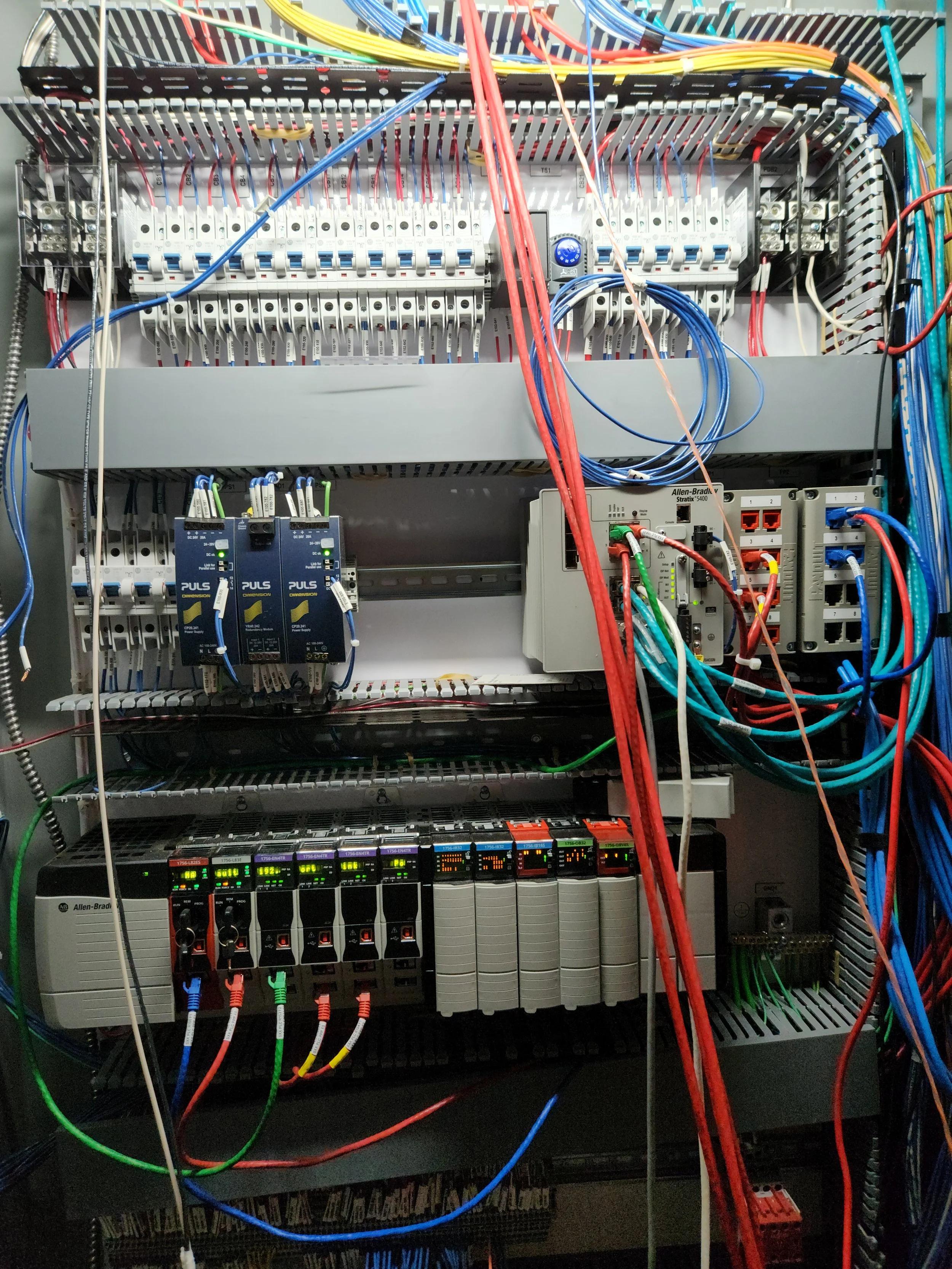
Control Panel Design & Engineering
Panel layout and component selection coordinated directly with the control architecture.
- Panel layout, component selection and sizing
- Coordinated directly with PLC/HMI architecture
- Power distribution, protection and thermal sizing
- Enclosure rating selection for plant environment
- Cable routing, segregation and wire numbering
- Vendor-neutral component specification
Electrical Schematics & IO Lists
The hardware-to-software interface, issued as a controlled drawing package.
- Structured IO list as the hardware-software interface
- Wiring diagrams, terminal and cable schedules
- Field device tagging and loop numbering standards
- Panel general arrangement and nameplate drawings
- Drawing packages issued in client-standard CAD formats
- As-built revision control and handover package
Standards & Compliance
Designed to the target listing: UL 508A, NFPA 79 and IEC 60204-1.
- UL 508A industrial control panel construction requirements
- NFPA 79 electrical standard for industrial machinery
- IEC 60204-1 safety of machinery: electrical equipment
- Short-circuit current rating (SCCR) considerations
- Component selection aligned to the target listing
- Documentation prepared for panel-shop certification
Industrial Edge Integration
A secure data path from the panel to the plant data platform.
- Edge gateway configuration and plant data links
- Protocol conversion between control and IT layers
- Secure data path from panel to data platform
- Store-and-forward buffering at the edge
- Foundation for condition and predictive monitoring
- Coordination with plant IT on network policy
Note: Control panels are designed to UL 508A construction requirements; the UL listing mark itself is applied by a UL-listed panel-building partner.
Standards applied
to this discipline.
Work in this category is developed against the published standards below, applied consistently regardless of the hardware vendor on the line.
Construction requirements for industrial control panels: component listing and selection, spacings and wire bending space, overcurrent protection, conductor sizing, field wiring provisions, marking content, and the short-circuit current rating calculation for the assembly.
- Component selection checked against the target listing
- SCCR determination for the assembly
- Nameplate, marking and certification documentation
Applies to the electrical equipment of industrial machinery not portable by hand. Covers supply circuit disconnecting means, overcurrent protection, control circuits and control functions, operator interface devices, conductors and wiring methods, and required technical documentation.
- Disconnect and overcurrent protection scheme
- Control-circuit voltage, grounding and colour conventions
- Wire numbering and technical documentation package
General requirements for the electrical equipment of machines: protection against electric shock, protective bonding and equipotential continuity, stop categories and emergency stop, control circuit safety, and the marking and documentation supplied with the machine.
- Stop category selection and emergency stop design
- Protective bonding and equipotential continuity
- Documentation for machinery supplied to IEC markets
Note: Control panels are designed to UL 508A construction requirements; the UL listing mark itself is applied by a UL-listed panel-building partner.
Twelve steps.
Every engagement.
Each engagement follows the same sequence from discovery through post-commissioning support, so scope, documentation and validation are never negotiated mid-project. Every step closes on a named deliverable.
Discovery
Review of existing equipment, process requirements and production constraints, including what is already installed and what cannot be interrupted.
Requirements Definition
Requirements captured and documented against client specifications and applicable process standards, so scope is agreed before design begins.
Functional Design Specification
Control philosophy, sequence of operations, interlocks and interface requirements written and approved before any software is developed.
IO List Development
A structured input/output list establishing the interface between field hardware and control software, and the reference for both wiring and logic.
System Architecture
Control network, hardware and communication architecture defined across the PLC, HMI, SCADA and MES layers, including addressing and segmentation.
Software Development
PLC, HMI and MES application development to IEC 61131-3 conventions against the approved FDS, using modular and documented code structures.
Simulation
Offline validation of logic and operator screens, including fault paths, before any equipment is available moving debugging off the production floor.
Factory Acceptance Testing
Structured functional validation against the FDS prior to shipment or site deployment, with defects logged and closed before mobilisation.
Site Acceptance Testing
On-site validation against the approved FDS under live equipment conditions, confirming behaviour matches what was specified and tested.
Commissioning
Equipment energization, sequence validation, interlock proving and production ramp-up support through to stable output.
Training
Operator and maintenance training on system operation, screen navigation and diagnostics, so the plant can run and troubleshoot the system itself.
Support
Post-commissioning remote and on-site support for optimization, change requests and issue resolution, with scheduled system health reviews.
Talk to the
engineer,
not a sales desk.
Production challenges involving unplanned downtime, retrofit planning, MES integration or new line commissioning can be reviewed directly with engineering leadership. Initial technical consultations are used to understand current control architecture, process constraints and desired outcomes before a proposal is issued.
Industrial Automation Project Engineer with 8+ years designing and developing PLC, HMI, SCADA and MES solutions for the automotive and material handling industries.